

What To Look For With Skin Cancers
Out of all the posts I've ever written, this is possibly the most important one I need you to read from start to finish. It will literally take you a few minutes and could save you or someone elses life...
After twenty two plus years of looking at skin all day, every day, I think one of the biggest lessons I've learnt is that skin cancer rarely looks how we expect it to.

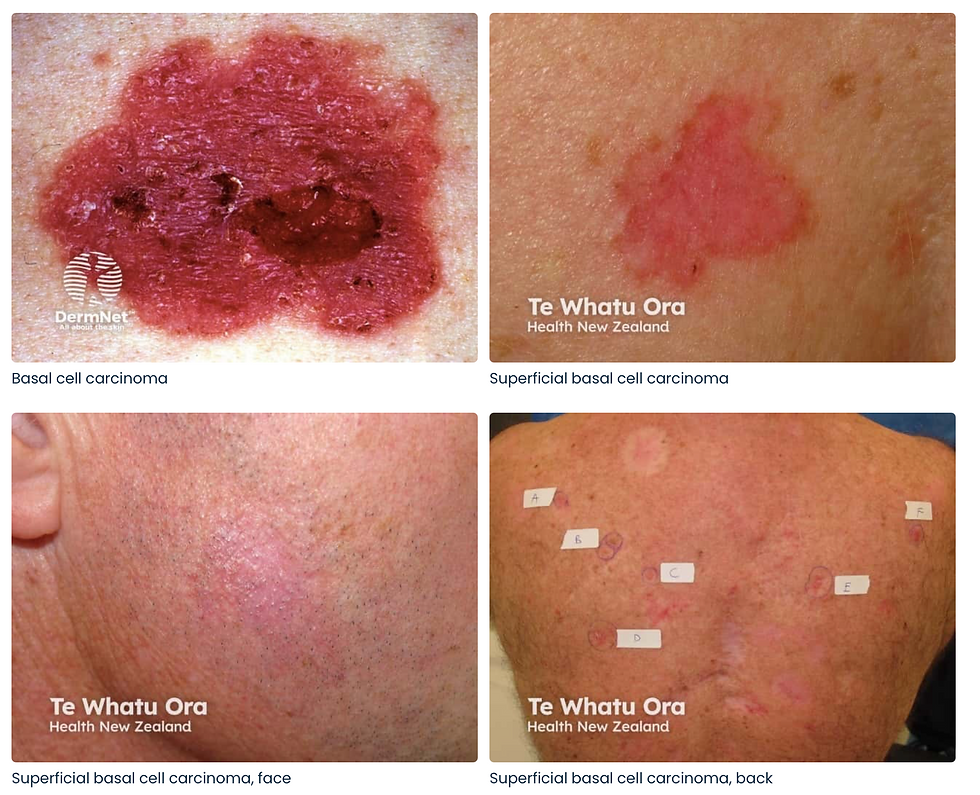
When I first became a facialist, I assumed skin cancers would always look obvious. I imagined these angry looking lesions that you could just immediately recognise as something serious, almost like a nasty infection. Then as time went on and as I learned more, it genuinely surprised me how subtle they can actually be. Over the years I've seen suspicious lesions that looked like nothing more than a small dry patch of skin, a flaky area of skin that was always there over and over again when clients came in, a tiny pink bump or what looked like a spot that just never healed up. Some clients had thought it was eczema, others people thought it was only dry skin or irritation from the weather. Unfortunately, skin cancers don't always look as dramatic as we expect them to.
Before I go any further though, I should say that I'm absolutely not diagnosing skin cancer. That isn't my role and this blog should never replace advice from your GP or a dermatologist. My job is simply to help people become more aware of their skin and, if I ever see something during a treatment that concerns me, I always advise my client to get it checked. I'd much rather be completely wrong than tell somebody not to worry and miss something important.
One thing I have become increasingly aware of over the last few years is the amount of misinformation surrounding skin cancer and spf online. Apparently SPF causes cancer (FYI it doesn't!), you don't need it because of Vitamin D (FYI you could just stick your arm out of the window to get vitamin D - we absorb it all over our skin), seed oils are to blame, a healthy tan protects you (stop with this nonsense)... honestly, I don't know where some of this comes from anymore. It worries me because skin cancer isn't something to we can just take lightly. If social media has taught us anything, it's that just because something is said with confidence, it doesn't mean it has any credibility.
There are lots of different types of skin cancer, but the three you're most likely to hear about are basal cell carcinoma (BCC), squamous cell carcinoma (SCC) and melanoma.
Sorry these pictures are so ugly but I had to share so you know what to look out for...
Basal cell carcinoma is the most common and thankfully is usually slow growing. It often appears as a shiny lump, a sore that doesn't heal or a patch that constantly crusts over.

Squamous cell carcinoma can sometimes look like a rough, scaly area of skin or a persistent sore and, although it's still very treatable, it has a greater chance of spreading than a basal cell carcinoma if it's ignored.

Melanoma is the one we worry most about because it has the greatest potential to spread to other parts of the body if it isn't detected early. Not every melanoma behaves the same way, but some can change surprisingly quickly, which is why it's never worth adopting a "I'll leave it for a few months and see what happens" approach.

One of the easiest ways to remember what to look out for is something called the 'ABCDE' rule. It's not perfect and it certainly doesn't pick up every skin cancer, but it's a very useful starting point to bear in mind.
The "A" stands for asymmetry. In other words, one half of the mole doesn't match the other.
"B" is for border, so you're looking to see whether the edges have become uneven, blurred or irregular.
"C" stands for colour because healthy moles are often one fairly even colour, whereas concerning lesions can contain different shades of brown, black, red, blue or even white.
"D" is for diameter. Traditionally, we were taught to be more cautious of anything larger than six millimetres, although melanomas can absolutely be smaller than this.
"E" stands for evolving, and in my opinion it's probably the most important letter of the lot. If a mole is changing in shape, size or colour, or if it suddenly starts itching, bleeding, crusting or behaving differently, it deserves to be looked at.
There's another sign that dermatologists often talk about which I think is really useful too, and that's called the "Ugly Duckling Sign". Most of us have moles that look fairly similar to one another. If one suddenly looks completely different from all the others, even if it doesn't tick every ABCDE box, it's worth getting somebody to take a closer look. It doesn't automatically mean it's cancer, but it does mean it's different enough for you to give it some attention and get it looked at.
As I've already mentioned, one of the things that shocked me most when I started in this industry was just how innocent some suspicious lesions can appear. They don't always look super dramatic, ulcerated or terrifying to look at (like what we're taught in text books). Sometimes they're simply a dry patch that never heals up, a little scab that constantly comes back or even a tiny area that just doesn't look right. That's why I always tell clients to trust their instincts. If something has changed or you're repeatedly finding yourself looking at the same area of skin thinking, "That's a bit odd," it's always worth booking an appointment with your GP.
The good news is that there are lots of things we can do to reduce our risk. Wearing SPF every day is one of the simplest and most effective habits you can build into your routine. I always recommend applying roughly two finger lengths of sunscreen to your face and neck every morning, and if you're spending prolonged periods outdoors, don't forget to reapply throughout the day. Wearing a hat, staying in the shade during the hottest part of the day and of course avoiding burning are all incredibly sensible habits too.
Nimue SPF's are always my go to product. If you're interested in purchasing, just click the order link here.

I also think it's worth getting into the habit of checking your own skin every now and then. Ask your partner, friend or family member to have a look at areas you can't easily see yourself, such as your back, and if you have a mole you're keeping an eye on, take a photograph of it with a ruler next to it. It sounds a bit over the top, but having something objective to compare against over the following months can make it much easier to spot those subtle changes.
One thing that I hear a lot online that really riles me up is that SPF somehow causes more harm than good. I honestly find it infuri.
Yes, we all need Vitamin D, but you don't need to burn to make it! Yes, you can still get skin cancer in the UK even when it's cloudy because ultraviolet rays will easily travel through cloud cover. No, having a tan doesn't mean your skin is protected. In fact, a tan is actually your skin responding to damage. And although darker skin tones have a lower risk of developing skin cancer than fairer skin, they absolutely are not immune, which is another dangerous myth that continues to circulate online.
Ultimately, my biggest piece of advice is to trust yourself. You know your own skin better than anyone else. If something doesn't look quite right, if it's changed or if you're worried about it, go and get it checked. If you're still concerned after that appointment, don't be afraid to ask for a second opinion either. I'd much rather somebody feel slightly embarrassed about having a harmless mole looked at than not spotting something sooner.
Please wear your SPF, check your skin regularly and don't ignore something simply because it doesn't look particularly scary.
Sometimes the things that look the most innocent are the ones that need the most attention.
Thank you so much for reading,
Emmaline


Comments